
The New Golden Age of American Dining: Between Extreme Luxury, Excess, and Ostentation

While the culinary narrative in Italy seems to revolve almost exclusively around the trattoria and traditional folk cuisine as the only legitimate dining model, elsewhere the table has taken a different path—undoubtedly a more brazen one. And without any fear of using the word luxury. In the United States, in particular, the restaurant industry is experiencing a new era of unabashed glitz, where opulence and theatricality create a sense of prosperity, and the menu becomes a faithful mirror of an economy—for the few, of course—that rewards a willingness to pay for the privilege of the experience.
There was a time when the term conspicuous consumption evoked steel tycoons and monumental mansions rather than dishes served at a restaurant. Yet today, in American dining’s new gold rush, food itself has become the emblem of a brand-new Gilded Age. Manhattan leads the charge, but this long wave of gastronomic lavishness is spreading far beyond.
As reported by The New York Times, luxury is on full display in the city's newest restaurants, without much modesty either. At Le Chêne, an intimate West Village bistro where one might expect boeuf bourguignon and bouillabaisse, the menu instead features a $435 tomahawk steak and a $260 turbot fillet. At Lex Yard, inside the renovated Waldorf Astoria, the lobster roll is dressed up with caviar and truffle, reaching $68. And at La Grande Boucherie, for those with tight schedules who can book well in advance, a whole roasted suckling pig for the table is offered for the modest sum of $600.
Across the city, aspiring Rockefellers enthusiastically indulge in old-world luxuries—foie gras, Dover sole, mountains of shellfish—alongside modern delicacies like crudo, sea urchin, and o-toro. “Diners write to us asking what extraordinary items we have that evening, without ever asking about the price,” says chef Alexia Duchêne of Le Chêne, who spends about $1,000 on every turbot imported from France. Duchêne explains that this was one of the reasons she moved to the U.S.: in Europe, quality ingredients are expensive, but customers remain thrifty. “Here,” she says, “the more expensive it is, the faster it sells.”
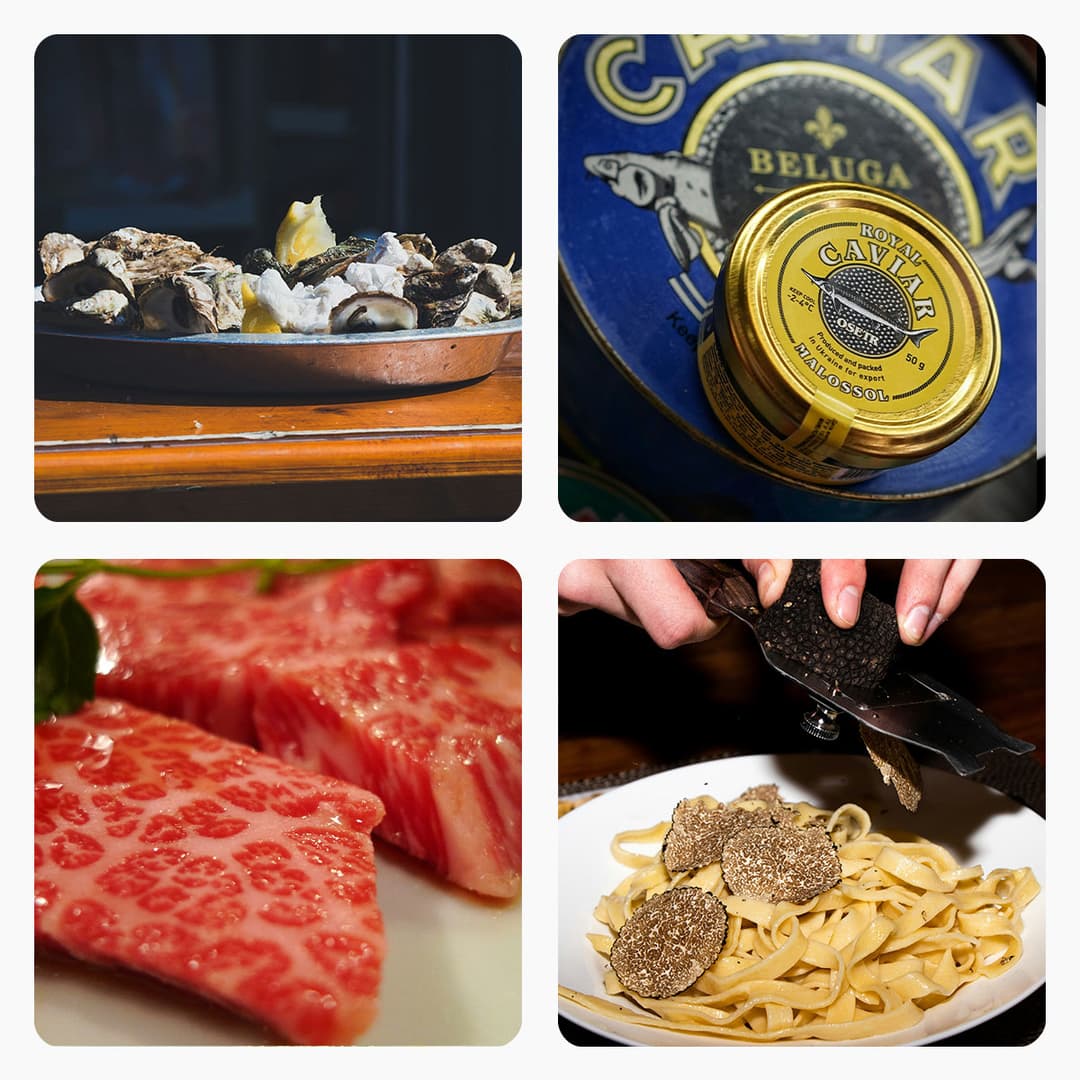
The wealthy have always been happy to spend on fine dining, but today prices are reaching previously unthinkable heights, and it is no longer an exclusive New York phenomenon. In Dallas, Las Vegas, Miami, or Aspen, restaurants designed for the 1%—the ultra-wealthy—nonchalantly serve up Wagyu tastings and generous showers of shaved truffles. Even more casual spots are offering fancy upgrades: caviar alongside Martinis, sprinkled on french fries, or even crowning chicken nuggets. A famous case in point is Coqodaq, a Korean fried chicken restaurant that sold six-piece nugget boxes topped with Petrossian caviar for $100 at the US Open.
According to Emily Sundberg, author of the newsletter Feed Me, luxury is often more theatrical than gastronomic: “The mise-en-scène matters just as much as the gold leaf on the o-toro. A lot of people order it for the photo, and then leave it on the plate.”
This opulence exists alongside an increasingly divided America, reflecting what economists call a K-shaped economy—a recovery that benefits the wealthy while inflation and wage stagnation erode everyone else's purchasing power. Today, the top 10% of U.S. households account for nearly half of total consumer spending, according to Moody’s Analytics. And just like airlines, credit card companies, and couture brands, restaurants are eagerly chasing that exact segment.
It is no coincidence that Dominique Crenn partnered with LVMH for the menus aboard the Orient-Express and at the Dior restaurant in Beverly Hills. Meanwhile, in Las Vegas, next door to the new Carbone Riviera, the yacht manufacturer Riva docked a 33-foot yacht that sails across the Bellagio lake with guests on board. “People want to celebrate, they want to spend,” says Elizabeth Blau, a veteran restaurant developer in Las Vegas. “Why not offer them organic chicken and giant tomahawks in a lavish dining room?”
For many operators, excess is also a survival strategy amidst soaring costs for rent, labor, and ingredients. “It’s the only way to guarantee a margin,” argues pastry chef Fabián von Hauske Valtierra, co-founder of Contra—an iconic restaurant of 2010s creative New York dining that opened with a $55 tasting menu and closed its doors in 2023.
After decades in which American cuisine built its prestige on creativity, farm-to-table ethics, and cultural authenticity, the flagship dishes of this new era recall those of a previous century: large roasts, game, and whole fish shipped from distant seas. Carbone Riviera offers sea bream for $75, turbot for $295, and sea bass for $325. Michael White’s Santi features a whole rabbit for the table at $140. These are dishes designed to be shared at the table—and on social media.
Manhattan remains the ultimate stage for this unrestrained spending, where the dining and real estate industries are inextricably linked. Many of the most expensive recent restaurant openings serve as anchor tenants for luxury office towers: Santi at 270 Madison Avenue, Jean-Georges’ Four Twenty Five at 425 Park Avenue, and Daniel Boulud’s La Tête d’Or at One Madison Avenue. “Opulent restaurants confirm the building’s standing in the symbolic order of luxury,” notes real estate analyst Jonathan Miller.
Since the turn of the 21st century, developers have competed to attract chefs capable of drawing affluent clientele. Following the pandemic, this alliance became crucial in luring workers back to the office. “It’s a true generational shift,” explains Marc Holliday, CEO of SL Green. “Those who can work remotely need to be seduced by design and high-end dining.”
Within his new culinary empire, Boulud created Cuisine Boulud, a corporate catering division offering private dinners, desk-side lunch deliveries, and grab-and-go cafés. At street level, La Tête d’Or serves Wagyu for $160 for a four-ounce portion, alongside a $130 Grand Plateau Royal of shellfish. “These aren't cheap operations,” Holliday remarks, referring to the heavy investments required to integrate multiple kitchens and formats into a single building.
Yet some manage to cater to two seemingly distinct audiences at once. Two of the city's hottest new spots, The Eighty Six and The Corner Store, feature menus that blend extravagant showstoppers with comfort food classics—both priced at a premium. The Eighty Six, a West Village speakeasy, serves a $110 lobster and a $165 whole roasted duck, but the menu also features a $39 cheesesteak and complimentary Danish butter cookies served right out of their tin.
At its sister restaurant, The Corner Store, an $89 Dover sole shares menu space with a $24 spinach and artichoke dip, $20 pizza rolls, and a French dip sandwich that can be upgraded with premium Wagyu beef for $39. It's a high-low approach that is rapidly expanding across New York and beyond.